Gift cards and gift baskets have their place, but the items that spark bidding wars are usually experiences. A chance to conduct an orchestra, name a litter of puppies, or spend the night camping on a nature preserve gives guests something they can’t buy anywhere else. It also gives them a story they’ll tell for years.
Experiences are often easier to procure than physical goods, too. Many of the best ones come from your own staff, volunteers, spaces, and community connections, and they cost your organization little or nothing. Learn more about why experiences make great auction items and how to source them for free.
Below are 75 silent auction experience ideas. We start with crowd-pleasers that work at almost any event. Then we break the list down by type of organization, with ideas tailored to your mission and your audience.
Crowd-Pleasing Experiences for Any Event
These ideas work for nearly any audience and are a strong foundation for any auction catalog.
Chef’s Table at Home. A local chef cooks a multi-course dinner for eight in the winner’s kitchen.
Pasta-Making Night. A hands-on class with a local restaurant owner, followed by dinner and wine.
Hot Air Balloon Ride. A sunrise flight for two, with a champagne toast on landing.
Pilot for an Afternoon. A discovery flight lesson at a nearby airfield, where the winner takes the controls with an instructor.
Lake House Weekend. A supporter donates a weekend at their vacation home or cabin.
Dawn at the Bakery. A behind-the-scenes morning with a local baker, with fresh pastries to take home.
Backyard Concert. A local band or musician plays a private set at the winner’s party.
Murder Mystery Dinner Party. Your board hosts a themed dinner party, costumes and all.
Progressive Dinner. Appetizers, entrées, and dessert at three local restaurants, with a driver between stops.
Family Photo Session. An outdoor session with a local photographer at a favorite spot in town.
Mystery Date Night. A series of sealed envelopes reveals dinner, an activity, and a surprise, one at a time.
VIP Night at Next Year’s Event. Early entry, the best table, a welcome toast with your leadership, and a backstage look at how the event comes together.
The most memorable silent auction experiences reflect who you are. Look at the people, places, and traditions that make your organization unique, and you’ll find experiences no store can offer. Mix a few crowd-pleasers with ideas tied to your mission, and your guests will be excited to bid from the moment the auction opens.
Ready to Run Your Next Auction?
AuctionSnap makes it easy to showcase your experiences with mobile bidding for in-person, online, and hybrid auctions. Book a demo or view pricing to get started.
A silent auction is one of the most flexible fundraisers a nonprofit can run. It works at a black-tie gala, a school carnival, a 5K finish line, or entirely online. Guests browse donated items, place bids over a set period, and the highest bidder wins when bidding closes.
Silent auctions look simple from the guest side. Behind the scenes there are many moving parts: procurement, pricing, promotion, bidding, checkout, and follow-up. This guide walks through each step in order, with links to deeper resources along the way.
What Is a Silent Auction?
At a silent auction, guests bid on items without an auctioneer calling out prices. Bidding happens in one of two ways. Guests can write their bids on paper bid sheets, or they can use a mobile bidding platform on their phones.
Bidding stays open for a set window, anywhere from an hour during an event to several days online. When bidding closes, the highest bid on each item wins.
Silent auctions are different from live auctions. A live auction features a small number of high-value items sold by an auctioneer in real time. Many events run both, often alongside a paddle raise.
Silent Auction Planning Timeline
For most nonprofits, three to four months of lead time is comfortable. Smaller school or community auctions can come together in six to eight weeks.
Timeframe
Focus
12 to 16 weeks out
Set goals and budget, choose a format, recruit a committee, choose software
8 to 12 weeks out
Procure items, secure sponsors, open ticket sales
4 to 8 weeks out
Price and package items, write descriptions, publish rules, begin promotion
In-person. Bidding happens at the event. This format has the highest energy and works well for galas, school events, and community gatherings.
Online. Bidding runs over several days, and anyone with the link can participate. It’s great for reaching supporters who can’t attend in person.
Hybrid. Online bidding opens before the event and closes during it. This extends your reach while keeping the excitement of a live close. See Nonprofit Hybrid Auctions 101 for the basics.
A silent auction also pairs naturally with events you may already run. For ideas, see:
Step 3: Build Your Auction Committee and Volunteer Team
Even a small auction runs more smoothly with clear roles. Common committee roles include:
Committee chair. Owns the timeline and keeps everyone on track.
Procurement lead. Recruits item donors and tracks commitments.
Marketing lead. Promotes the auction and the items.
Logistics lead. Handles venue layout, display tables, and item pickup.
Checkout lead. Manages payments and winner communications.
On event day, you’ll also need volunteers for check-in, bidder help, item runners, and checkout. Brief them ahead of time on how bidding works and where to send guests with questions.
Paper bid sheets still work for very small auctions. However, they create extra work at the end of the night. Volunteers have to read handwriting, tally totals, and chase down winners who already left.
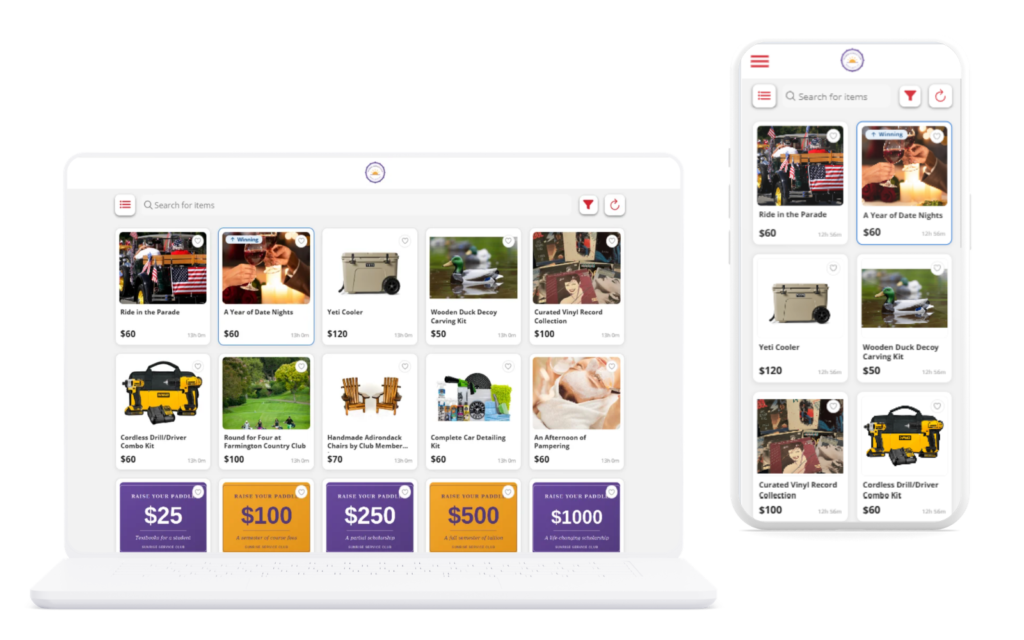
Mobile bidding software replaces that process. Guests register, browse items, and bid from their phones. They get notified when they’re outbid, and winners are determined automatically at close.
If you use DonorSnap: AuctionSnap is a separate product that integrates natively with DonorSnap. Bidder and winner information flows into your donor records instead of staying in a separate spreadsheet.
Step 5: Procure Your Auction Items
Your items drive your results. A common rule of thumb is one item for every two to three bidding households. Adjust based on your audience and goal.
Strong silent auction items usually fall into a few categories:
Experiences. Dinners, getaways, behind-the-scenes tours, and lessons tend to outperform physical goods. They’re also often easier to get donated. See why experiences make great auction items.
Local favorites. Restaurant gift cards, services from local businesses, and items tied to your community.
Themed baskets. Several smaller donations bundled into one more valuable package.
Bundling can turn a handful of modest items into something guests will compete for. A dinner certificate, a bottle of wine, and a movie gift card become a “Date Night” package with a much stronger perceived value.
Good item descriptions are short and specific. Each one should include:
A clear title that says what the item is
The fair market value
The donor’s name, if they’d like credit
Any restrictions, such as blackout dates, expiration, or location
A good photo
For experiences, describe what the winner will actually do and enjoy. A plain list of what’s included is less persuasive.
Step 8: Set Your Silent Auction Rules
Clear rules prevent confusion and disputes. Publish them in your online catalog and at check-in, and cover:
Who can bid, and whether registration is required
When bidding opens and closes
How winners are determined and notified
Accepted payment methods and when payment is due
Item pickup times and what happens to unclaimed items
Whether items can be returned or exchanged (usually not)
An auction can also bring new people into your orbit, since guests often bring friends who have never given to your organization. How to Cultivate New Audiences for Your Nonprofit covers how to welcome them.
Step 10: Prepare Guests for Mobile Bidding
The biggest barrier to mobile bidding is unfamiliarity, not the technology itself. A little preparation goes a long way:
Send registration instructions before the event.
Open item previews a few days early to build anticipation.
Station volunteers at check-in to help guests get started.
Some guests may prefer not to use their phones. AuctionSnap lets volunteers enter bids on a guest’s behalf, so everyone can participate.
Layout. Place items along the natural flow of the room, with your strongest items where guests gather. Group items by category if you have a large catalog.
Announcements. Remind guests of closing times throughout the night, with a final countdown before bidding closes. Energy peaks in the last few minutes.
You can also add revenue alongside the silent auction:
Paddle raise (fund-a-need). Guests give at set levels toward a specific need. AuctionSnap supports paddle raises by assigning paddle numbers to guests. See Paddle Raises: The Art of Fund-a-Need.
Then keep the momentum going. Many auction guests are new to your organization or give only once a year. How to Maximize Post-Event Engagement covers ways to turn bidders into ongoing supporters.
If you use DonorSnap: AuctionSnap’s native integration lets you bring bidder and winner data into your donor records. From there, you can:
Before details fade, gather your committee and look at:
Total raised compared with your goal, and net revenue after costs
Which items and categories drew the most bids
Which items sold below value or didn’t sell
Participation rate: how many guests placed at least one bid
Feedback from guests, volunteers, and item donors
Save these notes with your item and donor lists. Next year’s auction will be easier because of them.
Final Thoughts
A successful silent auction comes down to planning ahead, choosing items your guests actually want, and making it easy for everyone to bid and pay. Start with a clear goal, lean on your committee and volunteers, and use the right tools to handle the details. Don’t forget the follow-up: the relationships you build with bidders, item donors, and volunteers after the event are what make next year’s auction even stronger.
Ready to Run Your Silent Auction?
AuctionSnap gives nonprofits simple, affordable mobile bidding for in-person, online, and hybrid auctions. Book a demo to see how it works, or view pricing to get started.
An auction can turn a good fundraiser into a great one. Guests get excited, local businesses get a chance to show their support, and your organization brings in revenue beyond ticket sales. Running an auction with paper bid sheets, spreadsheets, and a long checkout line can quickly overwhelm your volunteers, though. That’s where auction software for fundraisers comes in.
In this guide, we’ll cover why an auction is worth adding to your next event, which types of fundraisers benefit most, how the right software makes the whole process easier from setup to checkout, and how some of the most popular auction platforms compare.
Why Add an Auction to Your Fundraiser?
An auction adds a second revenue stream to your event without requiring a second event. Guests who already bought a ticket or registered for your walk now have another way to give, and many will spend more at an auction than they would through a straight donation ask because they walk away with something they value.
Auctions also create energy. Friendly bidding wars, last-minute bids, and the reveal of winning items give guests something to talk about and a reason to stay engaged throughout the event.
They’re also a natural way to involve your wider community. Local restaurants, shops, and service providers who might not write a check are often happy to donate a gift card or experience, which gives them visibility with your supporters and strengthens those relationships for future years.
And with online bidding, your auction can reach supporters who can’t attend in person, including alumni, former members, out-of-town family, and anyone who wants to help but has a scheduling conflict.
What Types of Fundraisers Should Include an Auction?
Almost any fundraising event can benefit from an auction. Here are some of the most common fundraisers where auctions work especially well.
Community Events
Festivals, holiday markets, fun runs, and community galas already bring people together, which makes them a perfect fit for an auction. A silent auction at a community event gives attendees a way to support local causes while discovering local businesses. Online bidding lets you open the auction a week or two before the event, building excitement and giving the whole community a chance to participate.
Service Club Events
Rotary, Lions, Kiwanis, Elks, and other service clubs rely on fundraisers to support scholarships, local grants, and community projects. Auctions are a staple at service club events like annual dinners, pancake breakfasts, and golf outings. Because service club members tend to have deep ties to local businesses, securing donated auction items is often easier, and auction software helps volunteer-run clubs manage those items without adding hours of work.
School Fundraisers
PTA and PTO auctions, booster club events, and school galas are some of the most popular auction fundraisers around. Classroom baskets, teacher experiences, “principal for a day,” reserved parking spots, and student artwork all make great school auction items. Online auctions work especially well for schools because busy parents can bid from their phones during pickup, practice, or after bedtime.
Church Fundraisers
Church dinners, bazaars, youth group fundraisers, mission trip fundraisers, and building campaigns are all great opportunities for an auction. Handmade quilts, baked goods, home-cooked dinners hosted by members, and vacation home stays donated by parishioners are often among the most popular items. An online church auction also helps homebound members and families who have moved away stay connected and involved.
Other Fundraisers That Benefit From Auctions
Galas, golf tournaments, animal rescue fundraisers, sports team fundraisers, arts organization benefits, and nonprofit anniversary celebrations are all strong candidates for an auction. If your event has guests who care about your cause, an auction gives them another meaningful way to support it.
How Does Auction Software Help Your Fundraiser?
Auction software for fundraisers replaces paper bid sheets, manual tracking, and handwritten receipts with a system designed to make your auction easier to run and more profitable. Here’s how.
Simplifies Auction Setup
Instead of juggling item lists in spreadsheets, you can add each item once with its photo, description, value, starting bid, and bid increment. Your auction catalog is ready for guests to browse online, and your team has one place to see everything.
Makes Bidding Easy for Guests
With online and mobile bidding, guests can browse items and place bids from their own phones. No more crowding around tables, deciphering handwriting, or missing out because someone didn’t make it back to the bid sheet in time. Guests can bid from their seats, from across the room, or from home.
Supports Paddle Raises and Fund-a-Need Moments
A paddle raise, also called a fund-a-need, is often the most emotional and profitable moment of a fundraiser. Guests raise their paddles to give at set levels toward a specific need, like scholarships, a new van, or a year of meals. With AuctionSnap, each guest is assigned a paddle number, and every pledge is recorded under that number and added to their checkout automatically. No scribbled notes, no guesswork, and a paddle raise that moves as fast as the room does.
Takes the Stress Out of Checkout
Checkout is where paper auctions tend to fall apart. Volunteers have to tally bid sheets, match winners to items, and process payments while guests wait in line. Auction software tracks winners automatically and handles payment processing, which means shorter lines, fewer errors, and happier guests at the end of the night.
Helps You Raise More With Buy-It-Now Items
Not every guest wants to compete in a bidding war, and not every guest has the budget for your top items. Buy-it-now items give everyone a way to participate by offering fixed-price items that multiple people can purchase. Think branded merchandise, local gift cards, experiences, or mission-related items like coffee from a partner community or artwork made by the people you serve.
In AuctionSnap, you can mark an item as buy-it-now only, choose whether it’s available online or in person only, and set the quantity you have on hand. The system tracks inventory automatically and shows how many are left, which also creates a little urgency as quantities run low.
A paper auction only reaches the people standing in front of the tables. An online auction can open days before your event and reach supporters anywhere. That means more bidders, more competition on your best items, and more revenue for your cause.
Frees Up Your Volunteers
Most fundraisers run on volunteer power. When software handles bid tracking, winner notifications, and payment, your volunteers can focus on greeting guests, telling your story, and making the event memorable instead of doing math at a folding table.
What Other Features Help Auctions at Fundraisers?
Beyond the basics, a few features can make a noticeable difference in how much your auction raises:
Volunteer bid entry. Not every guest wants to bid from their phone. Volunteers can enter bids for guests through the admin panel for silent auctions, live auctions, and paddle raises, keeping your auction accessible to everyone.
Outbid notifications. When guests get an alert that they’ve been outbid, many will jump back in with a higher bid. This keeps bidding active and drives up final prices.
Maximum bidding. Letting guests set a maximum bid means the system can bid on their behalf up to their limit, which keeps them competitive even when they’re busy enjoying the event.
Item photos and detailed descriptions. Great photos and clear descriptions help items sell, especially online. Include the item’s value, any restrictions, and who donated it.
Reporting. After the event, you’ll want to know what sold, for how much, and who bought it. Good reporting makes it easy to thank donors, acknowledge item sponsors, and plan next year’s auction.
Donor data you can use later. Every bidder is a potential long-term supporter. If your organization uses DonorSnap, AuctionSnap syncs natively, which means your auction participants and their activity flow into your donor records for follow-up and stewardship.
Best Auction Software for Fundraisers
The right auction platform depends on your organization’s size, budget, and the tools you already use. Here’s a quick look at some of the most popular options.
AuctionSnap: Best Overall for Nonprofits That Want Connected Fundraising Tools
AuctionSnap offers online and mobile bidding, paddle raise and fund-a-need support, volunteer bid entry, buy-it-now items, and integrated payment processing. It’s a great fit for schools, churches, service clubs, and community organizations that want a full-featured auction without a complicated setup. AuctionSnap also integrates natively with DonorSnap, a donor CRM, and EventSnap, an event registration and ticketing platform. DonorSnap users can sync auction participants directly into their donor records for follow-up and stewardship.
OneCause: Best for Larger Organizations With Bigger Budgets
OneCause is a well-established fundraising platform offering auctions alongside event management, peer-to-peer fundraising, and other giving tools. It’s a strong option for larger nonprofits running high-dollar galas that have the budget for an enterprise-level solution.
Handbid: Best for Organizations That Want Concierge-Level Service
Handbid is known for mobile bidding and hands-on event support, making it a good fit for larger organizations that have the budget for a full-service experience. It doesn’t include its own donor CRM, so organizations will need to connect it to a separate CRM to manage supporter data.
Soapbox Engage: Best for Salesforce Users
Soapbox Engage is built around Salesforce, with auction bids, purchases, and paddle raises syncing directly into Salesforce records. If your organization already runs on Salesforce, it’s worth a look.
Givebutter: Best for Nonprofits Comfortable With a Tipping Model
Givebutter offers free auctions supported by optional donor tips. Supporters are asked to add a tip to Givebutter at checkout, and organizations that turn tips off pay a flat platform fee instead. It’s a good option for organizations whose supporters are comfortable with the tip request.
32auctions: Best for Simple Online Silent Auctions
32auctions focuses on straightforward online silent auctions and offers a free plan for smaller auctions. It’s a good fit for groups that want a simple silent auction and don’t need dedicated tools for paddle raises or more complex event-day features.
Frequently Asked Questions About Auction Software for Fundraisers
What is auction software for fundraisers? Auction software for fundraisers is a tool that helps nonprofits, schools, churches, and community groups run silent, online, and mobile auctions. It typically handles item management, bidding, winner tracking, and payment processing in one place.
What is the best auction software for fundraisers? The best auction software for fundraisers depends on your needs. AuctionSnap is a strong all-around choice for nonprofits that want online and mobile bidding, paddle raise support, and native integration with DonorSnap and EventSnap. OneCause and Handbid serve larger organizations with bigger budgets, Soapbox Engage is built for Salesforce users, Givebutter uses a tip-supported model, and 32auctions works well for simple online silent auctions.
Can I run an auction without an in-person event? Yes. Many organizations run fully online auctions that stay open for several days. Supporters can browse and bid from anywhere, making it a great option for groups without a venue or budget for a large event.
Is mobile bidding hard for older guests? Most guests find mobile bidding simple once they place their first bid. For anyone who prefers not to use a phone, volunteers can enter bids on their behalf through AuctionSnap’s admin panel.
What is a paddle raise at a fundraiser? A paddle raise, also called a fund-a-need, is a live giving moment where guests raise their paddles to donate at set amounts toward a specific cause. Guests don’t receive an item in return. Their gift goes directly to the need being funded.
What types of auction items raise the most money? Experiences, travel, unique local offerings, and items tied to your mission tend to perform well. Pairing high-value items with lower-priced buy-it-now options helps you capture revenue from guests at every giving level.
Ready to Make Your Next Fundraiser Auction Easier?
Whether you’re planning a school gala, a church dinner, a service club event, or a community festival, the right auction software for fundraisers helps you raise more while giving your team and your guests a better experience. AuctionSnap offers online and mobile bidding, paddle raise and fund-a-need support, volunteer bid entry, buy-it-now items with built-in inventory tracking, and integrated payment processing to help your next auction run smoothly from start to finish.
Book a demo to see how AuctionSnap can help your next fundraiser.
Starting Bids and Increments Explained For Nonprofit Auctions
You have secured the items. The online catalog is built or the bid sheets are printed. Now comes the question that stalls a lot of auction planning: what number do you actually put in the starting bid field?
Set it too high and the item sits untouched all night. Set it too low and you leave money on the table, especially if your nonprofit paid for the item in the first place. The good news is that pricing silent auction items is not guesswork. There are proven rules of thumb, and once you understand the three numbers behind every item, you can price an entire catalog quickly and confidently.
This guide covers the three numbers you need for every item, the percentages that actually work, and how to adjust them by item type.
What Is Fair Market Value in a Silent Auction?
Every pricing decision begins with fair market value, or FMV. This is the retail price a bidder would reasonably expect to pay for the item somewhere else. For a $200 restaurant gift card, the FMV is $200. For a donated week at a lake house, you determine the FMV in conversation with the donor based on comparable rental rates.
FMV matters for two reasons. First, it is the foundation for your starting bid and increment math. Second, it is the figure your winning bidders may need for their own tax records, since the amount a bidder can treat as a charitable contribution is generally only the portion they pay above fair market value. Getting FMV right protects both your revenue and your donors.
One caution: do not inflate FMV to make an item look more impressive. An inflated value creates a starting bid that is too steep, and it can mislead bidders about what they are able to deduct.
The 3 Numbers to Set for Every Auction Item
Every silent auction item needs three pricing decisions:
Starting bid. The opening bid that gets the item into play. This is the single most important number for driving participation.
Bid increment. The minimum amount each new bid must raise the current bid. This controls how quickly the price climbs.
Buy It Now price (optional). A fixed price that lets an eager bidder skip the bidding and take the item immediately.
Get these three right and the item does most of the work itself.
What Percentage of Retail Should a Silent Auction Starting Bid Be?
The widely used rule of thumb is to set the starting bid at roughly 30 to 50 percent of fair market value.
The logic is behavioral. A low, fair entry point invites that crucial first bid. Once someone has bid, they tend to feel invested and are far more likely to bid again to defend the item. A starting bid set too high removes that first easy step, and the item stalls before any momentum builds.
Where you land inside the 30 to 50 percent range depends on the item:
Common, easy-to-value items like gift cards and electronics can open higher, around 40 to 50 percent, because bidders know exactly what they are getting and a higher opening still feels fair.
Unique or high-demand items where excitement runs hot can also support the higher end, since you want to capitalize on the competition.
Niche items and experiences with a less obvious value, like a travel package, benefit from a lower entry point around 30 percent to attract that first bid.
If your nonprofit purchased an item rather than receiving it as a donation, make sure the starting bid at minimum covers your cost, or use a reserve price if your platform supports one so the item cannot sell below what you paid.
How to Set Silent Auction Bid Increments
Once the item is in play, the bid increment keeps the price climbing. The common guideline is to set the increment at about 10 percent of fair market value, then round to a clean number like $5, $10, or $25 to keep bidding simple.
Increments deserve more attention than they usually get, because they have a real effect on your final total. Set them too high and you discourage the smaller step-up bids that build momentum. Set them too low and the price crawls upward all night without ever reaching the item’s real value.
A few adjustments help:
For higher-value items, you can hold increments near 10 percent of FMV or a touch higher to keep the climb meaningful without scaring off bidders.
If you are using mobile bidding, you can often run slightly smaller increments than you would on paper. Tapping a phone to raise a bid is effortless, so bidders make those frequent small increases more readily than they would by crossing out a line on a sheet.
You can also adjust increments once bidding is underway. If an item is drawing heavy interest, a larger increment captures more of that enthusiasm.
How to Set a Buy It Now Price
A Buy It Now price gives eager bidders the option to purchase an item outright rather than wait out the bidding. A common approach is to set it above fair market value, often in the range of 150 to 200 percent of FMV, so that an instant sale still clears a healthy margin for your cause.
Buy It Now works best for items with a clear retail value and for items you have in multiple quantities, like gift cards or bottles of wine, where an immediate sale is a win and does not remove your one showpiece item from the floor.
Silent Auction Pricing Chart by Item Type
Use this chart as a starting framework, then adjust based on your own audience and past results:
Item type
Starting bid (% of FMV)
Bid increment (% of FMV)
Gift cards and retail items
40 to 50%
5 to 10%
Electronics and technology
40 to 50%
5 to 10%
Experiences (dining, spa, local activities)
40 to 50%
5 to 8%
Travel packages
30 to 40%
5 to 8%
Unique or high-demand items
40 to 50%
10%
Worked example: a donated dinner-for-two package with a $150 fair market value might open at $60 to $75 (about 40 to 50 percent), climb in $10 to $15 increments (about 10 percent), and carry a Buy It Now price around $250 to $300 for a guest who does not want to wait.
Setting Auction Prices in AuctionSnap
Once you have your framework, the software is where you put it to work. In AuctionSnap, you set the starting bid and bid increment for each item as you build your catalog, and you can add a Buy It Now price on any item where it makes sense, so the pricing rules you have decided on are in place before a single bid comes in.
One feature worth knowing: you can lower a starting bid during the event. If an item is not drawing interest on auction night, you are not locked into the number you set, and a quick adjustment can get it moving.
Priced well, every item does its own quiet work: inviting that first bid, building momentum, and climbing toward its real value while your team focuses on the guests in the room.
When it comes to building your auction item lineup, it’s tempting to focus on things you can see, touch, and photograph in a gift basket. But if you’ve ever watched bidding stall out on a collection of donated merchandise while a weekend getaway drives a bidding war, you already know the truth: experiences win.
Here’s why experience-based auction items deserve a starring role in your next event, and how to source them without spending a dime.
What Makes an Experience Item Different from a Physical Item?
A physical item has a ceiling. Once a bidder knows what something retails for, that becomes the mental cap on what they’ll spend. Experiences don’t work that way.
When someone bids on a private cooking class with a local chef, a behind-the-scenes stadium tour, or a trip to a destination they’ve been dreaming about, they’re not comparing it to a price tag. They’re picturing themselves there. That emotional connection is what drives bids above and beyond what the experience would cost to buy outright.
Experiences also feel exclusive in a way products rarely do. Even if tickets to a local winery tasting are technically available to anyone, the version offered at your auction feels curated and special. That perception of uniqueness is powerful.
Do Experience Items Really Raise More Money Than Physical Items?
In most cases, yes. There are a few reasons experiences tend to outperform traditional goods at auction:
People assign personal value, not retail value. A bidder who has always wanted to try axe throwing or has never had the chance to take their family on a fishing charter will bid based on how much it means to them, not what it costs.
Experiences are harder to comparison shop. With physical items, bidders can pull up Amazon or Google in seconds. Experiences, especially locally sourced or one-of-a-kind ones, don’t have an obvious market price, which keeps bids competitive.
They appeal to bidders who already “have everything.” Your major donors often don’t need more stuff. A private winemaker dinner or a front-row experience at a local sporting event gives them something genuinely new to look forward to.
What Are the Best Experience Items for Nonprofit Auctions?
The best experiences for your auction will depend on your audience, but these categories consistently perform well:
Travel and Getaways Weekend cabin rentals, airline miles paired with hotel stays, and destination packages are perennial top performers. Even a “staycation” package at a local resort can generate serious bidding from supporters who just want a night away.
Food and Dining Private chef dinners, wine pairing experiences, cooking classes, and “chef’s table” reservations at popular local restaurants appeal to a wide range of bidders and are often easy to source from community relationships.
Entertainment and Access Concert tickets, sports season passes, backstage passes, private winery tours, and brewery tastings feel premium without always carrying a premium cost.
Once-in-a-Lifetime Opportunities These are your headline items: a ride-along with a local fire crew, a flight lesson, a behind-the-scenes tour of a facility your audience admires. These are the items people tell stories about later.
Local and Hyper-Personal Don’t underestimate the draw of something specific to your community. A private tour of a beloved local landmark, an afternoon with a well-known community figure, or a lesson with a respected local artist can outperform a generic package simply because it means something to the room.
Why Are Experience Items Easier to Manage Than Physical Donations?
If you’ve ever coordinated the storage, display, and transport of dozens of physical auction items, you already appreciate this benefit. Experiences require almost no logistics on your end.
There’s nothing to store, nothing to haul, and nothing to photograph on a table the morning of your event. A letter of donation, a certificate, or a simple printed card is all you need to represent the item. Your auction software handles the rest, from displaying the item description to collecting payment from the winning bidder.
This simplicity also means fewer things can go wrong. Physical items get damaged, go missing, or arrive late. An experience commitment from a local business doesn’t have any of those problems.
How Do You Source Free Experience Items for Your Nonprofit Auction?
The good news: most experience items cost your organization nothing because they’re donated by local businesses and community members. Here’s how to build that pipeline.
Start with your existing relationships. Restaurants, salons, fitness studios, golf courses, and entertainment venues regularly donate to nonprofit auctions because it gets their name in front of a room full of engaged community members. Reach out to businesses your board and volunteers already frequent.
Make it easy to say yes. Create a simple donation request letter that explains your mission, the size and profile of your audience, and what the business gets in return (recognition in your program, on your website, and during the event). The clearer you make the ask, the more responses you’ll get.
Think beyond businesses. Board members, volunteers, and major donors often have experiences to offer: a weekend at their lake house, a private tennis lesson, a tour of their business or property. Personal experiences can feel even more exclusive than commercially donated ones.
Ask early. Solicitation works best when businesses have time to plan. Start building your item list at least three months before your event.
How Should You Present Experience Items at Your Auction?
Even the best item will underperform if it isn’t presented well. A few tips:
Use vivid, specific descriptions. “Dinner for two at a romantic waterfront restaurant” is fine, but “A candlelit four-course dinner for two at [Restaurant Name], featuring locally sourced ingredients and a view of the harbor” creates a picture in the bidder’s mind.
Include all the relevant details. Blackout dates, expiration dates, party size limits, and any other restrictions should be clearly disclosed. Transparency builds trust and prevents problems after the event.
Add an image when possible. A photo of the restaurant, the resort, or the experience in action does more than any description can.
Let your auction platform do the heavy lifting. A good auction management tool makes it easy to display items attractively, track bids in real time, and send automated notifications to keep bidders engaged throughout the event.
Ready to Build Your Best Auction Lineup Yet?
Experience items aren’t just easier to manage; they’re the items your attendees will talk about, fight over, and remember. Building a strong experience-focused item lineup is one of the highest-leverage things you can do to increase your auction revenue.
Looking for tools to manage your auction from item setup through final payment? AuctionSnap is built specifically for nonprofits, with everything you need to run a smooth, successful event without a complicated setup or a big price tag. [Learn more about AuctionSnap.]