There’s something magical about walking into a room filled with beautifully decorated Christmas trees, each one telling a different story and supporting a great cause. Festival of Trees fundraisers have become beloved community traditions across North America, bringing together local businesses, creative decorators, and generous supporters, all while raising significant funds for nonprofits.
If your organization is considering hosting a Festival of Trees event (or looking to improve your existing one), this guide will walk you through everything you need to know to create a memorable, profitable fundraiser.
What Is a Festival of Trees Fundraiser?
A Festival of Trees is a fundraising event where multiple Christmas trees are decorated by sponsors (typically local businesses, community groups, or individual donors) and then auctioned off or raffled to raise money for a nonprofit cause. These events often take place at community centers, convention halls, or as part of larger holiday festivals in downtown areas.
The beauty of this fundraiser is that it combines visual appeal, community involvement, and competitive bidding to create an event that’s both festive and financially successful.
Where Festival of Trees Events Shine
These fundraisers work particularly well when integrated into existing community Christmas celebrations. You’ll often find them at:
Downtown holiday festivals and light displays
Community centers during the holiday season
Hospital or museum lobbies open to public viewing
Shopping mall common areas
Historic venues or event spaces
The key is choosing a location with good foot traffic where community members naturally gather during the holiday season. This maximizes visibility for your sponsors and increases bidding participation.
Getting Local Businesses on Board as Tree Sponsors
One of the biggest advantages of a Festival of Trees is that local businesses are usually eager to participate. Here’s why sponsoring a tree is an attractive opportunity for them:
Visible community presence during the busy holiday season
Positive brand association with charitable giving
Creative marketing opportunity to showcase their business personality
Networking with other local business leaders
Tax-deductible contribution to a worthy cause
When approaching potential sponsors, offer different sponsorship levels (perhaps $250, $500, and $1,000+) that include the tree, decorations, and recognition signage. Many businesses will jump at the chance to support your mission while getting their name in front of potential customers.
Making Your Festival of Trees Exciting and Memorable
The difference between a good Festival of Trees and a great one often comes down to creativity and engagement. Here are some ideas to make your event stand out:
Theme Categories Instead of just having random decorated trees, create categories that sponsors can choose from:
“Elegant Evening” (sophisticated gold and jewel tones)
“Hometown Heroes” (celebrating first responders, teachers, or local legends)
Add Interactive Elements
Create a “People’s Choice” award where visitors can vote for their favorite tree (small donation to vote)
Include a children’s tree decorating station for families
Host a tree lighting ceremony to kick off the event
Offer hot cocoa and cookies to create a festive atmosphere
Tell the Stories Each sponsored tree should have a placard that shares not just who decorated it, but why they support your cause. These personal connections inspire higher bids and deeper engagement.
Extend the Viewing Period Don’t limit your festival to just one evening. If possible, display the trees for several days or even a full week leading up to the auction close. This gives more people the chance to see them and bid.
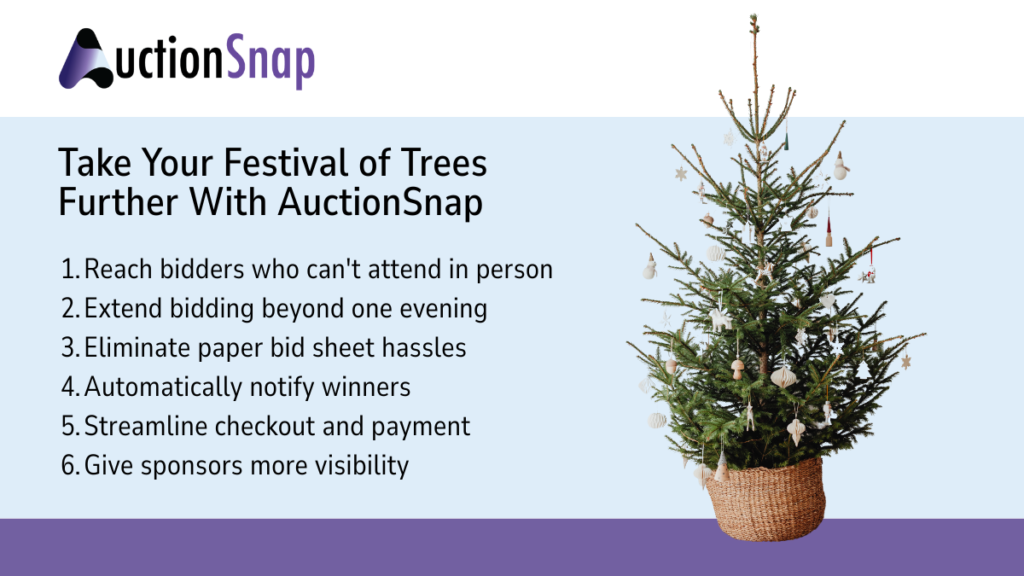
Take Your Festival of Trees Further With AuctionSnap
Here’s where many Festival of Trees events leave money on the table: they only allow in-person bidding during a specific timeframe. This means you’re missing out on supporters who can’t attend due to work schedules, family commitments, travel, or simply living in a different area.
Online Bidding Expands Your Reach
With AuctionSnap, you can run a hybrid auction that combines the excitement of in-person viewing with the convenience of online bidding. Here’s how it works:
Set up each sponsored tree as an auction item with photos and descriptions
Attendees can bid on their phones while walking through the festival
Supporters who can’t attend in person can view photos and bid remotely
Everyone sees real-time bid updates, creating competitive excitement
Bidding can extend beyond your physical event hours
This approach typically increases total revenue by 20-30% because you’re not limiting your donor pool to people who happen to be free on one specific evening.
Mobile Bidding Makes It Easy for Attendees
Even for people who are physically at your event, mobile bidding through AuctionSnap is more convenient than traditional paper bid sheets:
No need to track down a pen or wait in line to place a bid
Automatic outbid notifications keep people engaged
Easy payment processing when they win
Less staff time spent managing paper bid sheets and data entry
Guests can be notified instantly if they won
Tips for Festival of Trees Success
Start Early Begin recruiting tree sponsors at least 2-3 months before your event. Businesses need time to budget for sponsorships and plan their decorating.
Provide Clear Guidelines Give sponsors specific information about tree size, setup dates, decorating deadlines, and any theme requirements. The clearer your expectations, the smoother the process.
Market Like Crazy Use social media to showcase sponsor involvement as trees are claimed and decorated. Create anticipation by posting sneak peeks. Your sponsors will love the recognition, and potential bidders will get excited about attending.
Consider Delivery Large Christmas trees can be challenging for winners to transport. Offering delivery (for an additional fee or as part of sponsorship packages) makes bidding more appealing.
Have a Backup Plan Know in advance what happens to trees that don’t meet their reserve price. Some organizations keep them for their own offices, donate them to community spaces, or offer them to sponsors at a reduced rate.
Set Realistic Minimums For online bidding, set starting bids or minimum bids that reflect the actual value of a fully decorated tree plus your overhead, but not so high that you discourage early bidding.
Creating Holiday Magic While Raising Funds
A Festival of Trees fundraiser is more than just an auction. It’s a community celebration that brings people together during the most wonderful time of the year. By leveraging local business partnerships, creating an engaging in-person experience, and using AuctionSnap to extend your reach beyond physical attendees, you can turn this festive event into a significant revenue generator for your mission.
The combination of beautiful decorated trees, competitive bidding, and community spirit creates something special that donors remember long after the holiday season ends. And when you make it easy for anyone to participate (whether they’re strolling through your festival or browsing from their couch), you maximize both the impact and the income from your event.
Ready to start planning your Festival of Trees fundraiser? AuctionSnap makes it simple to manage both in-person and online auction components, so you can focus on creating a magical experience for your community.
It’s the night of your big fundraising event. Your guests are mingling, the energy is high, and the bidding has begun. But as the evening progresses, you notice certain auction items just aren’t getting the traction you hoped for. The bids are stagnant, the momentum is fading, and you’re starting to worry about whether you’ll hit your fundraising goals.
Don’t panic. Slow-moving auction items are a common challenge that nearly every nonprofit faces, but the good news is that with the right strategy and tools, you can turn things around, even mid-event. In this guide, we’ll walk you through proven strategies to get your auction items moving, with a special focus on how AuctionSnap’s powerful features can help you maximize your fundraising results.
Start By Procuring Auction Items Relevant to Your Guests
Before we dive into mid-auction rescue strategies, let’s address the foundation: securing the right items from the start.
If you want your auction items to move, you need to begin with items that resonate with your specific audience. While you can’t always predict what will or won’t generate excitement, over time you’ll develop a deeper understanding of your supporters’ preferences.
If this is your first auction or you don’t have historical data to reference, don’t worry. You can survey your supporters ahead of time to gauge their interests. Ask about their hobbies, favorite experiences, and price points they’re comfortable bidding on. You can also reach out to other similar organizations in your network and ask them which items consistently perform well at their auctions.
Preparing ahead of time ensures that on the night of your event, you have a well-balanced mix of items positioned to move. Think about including a variety of price points, experiences that appeal to different demographics, and unique items that can’t be found elsewhere.
Display Your Items Well
Even the most desirable auction items can underperform if they’re not presented effectively.
AuctionSnap makes it incredibly easy to showcase your auction items in their best light. With support for custom descriptions, intuitive filtering options, and multiple high-quality images, every item can be displayed professionally and attractively. When uploading photos, make sure you use good quality images with plenty of natural light. Blurry or dark photos will significantly reduce interest in even the most valuable items.
Tools like AuctionSnap also give you the ability to open your auction early and build momentum before the actual event. By giving guests access to browse items days or even weeks in advance, you create excitement, encourage early bidding, and give participants time to research and consider higher bids. This pre-event engagement often results in higher final bid amounts and more overall participation.
What to Do When Items Aren’t Moving During Your Auction
Now, let’s get to the heart of the matter. You’re in the middle of your event, and certain items just aren’t getting bids. Here’s your action plan, leveraging AuctionSnap’s features to turn things around in real time.
1. Send Targeted Broadcast Messages
Communication is key when auction momentum slows down. AuctionSnap’s broadcast messaging feature allows you to send in-app notifications to all participants currently browsing the event website.
Use this tool to:
Announce that bidding is closing soon for specific items
Highlight items that still need bids with compelling descriptions
Create urgency by mentioning limited time remaining
Share exciting updates like “Item #23 just received its first bid!”
For example, you might send a message like: “Only 15 minutes left to bid on the wine country getaway! Current bid is just $300—don’t miss this incredible opportunity!”
These real-time messages keep your guests engaged and can prompt action on items that have been overlooked.
2. Switch Items to “Buy It Now”
Sometimes guests are hesitant to bid because they don’t want to get into a bidding war or risk being outbid at the last minute. This is where AuctionSnap’s “Buy It Now” feature becomes invaluable.
For items that aren’t moving through traditional bidding, you can enable or adjust the “Buy It Now” price, allowing guests to purchase the item immediately at a set price. This is particularly effective for:
Items with limited quantities that create fear of missing out
Experiences that are time-sensitive or highly desirable
Merchandise or packages that have a clear retail value
Items where you’re confident the Buy It Now price still represents good fundraising value
The Buy It Now feature removes the uncertainty for bidders and can result in immediate purchases that might never have happened through traditional bidding alone.
3. Lower the Starting Bids
If you’ve set starting bids too high for certain items, you may be inadvertently discouraging participation. AuctionSnap gives you the flexibility to adjust starting bids even during the auction.
If an item has received zero bids after a reasonable amount of time, consider lowering the starting bid to make it more accessible. A lower entry point can:
Encourage hesitant bidders to make that first bid
Create competition once bidding has started
Generate momentum that drives the final price higher than you might expect
Remember, some money is better than no money. An item that sells for $200 after you lowered the starting bid from $500 to $100 is still $200 more than you would have raised if it received no bids at all.
4. Leverage Manual Bid Entry for In-Person Excitement
For live, in-person events, don’t forget that AuctionSnap supports hybrid bidding models. If you have a charismatic auctioneer or emcee, they can call attention to items that aren’t moving and collect verbal bids from the crowd. These bids can then be quickly entered through AuctionSnap’s Manual Bid Entry page by your admin team.
This approach combines the excitement of traditional live auction dynamics with the convenience and tracking capabilities of modern auction software. Sometimes guests just need to hear the energy in the room and see others bidding to feel motivated to participate themselves.
5. Bundle Items Together
If individual items aren’t attracting attention, consider creating impromptu bundles. For example, if you have a restaurant gift certificate and a wine basket that are both underperforming, you could combine them into a “Perfect Date Night” package. While AuctionSnap requires some advance planning for optimal item setup, you can update descriptions in real-time to reflect new bundles and communicate these changes through broadcast messages.
6. Extend Your Auction Timeline
One of AuctionSnap’s most flexible features is the ability to customize bidding open and close times. If you’ve enabled the “Allow custom bidding open/close by location” feature in your Event Settings, you can extend the bidding window for specific items or entire categories.
This is particularly useful when you realize certain items need more time to generate interest. You can announce through a broadcast message that select items will remain open for bidding for an additional 30 minutes, giving guests who may have missed them earlier a second chance.
What to Do With Nonprofit Auction Items That Don’t Sell
Despite your best efforts, some items simply won’t sell during the event. But that doesn’t mean all is lost. AuctionSnap provides several options for maximizing the value of unsold items after your event concludes.
Continue the Auction Online
One of the many benefits of AuctionSnap is the ability to extend your auction beyond the physical event. Instead of packing up unsold items and considering the opportunity lost, you can keep the auction open online.
Here’s how to make this strategy work:
Send a follow-up email to all your supporters, including those who couldn’t attend the event, highlighting the success of the evening and then creating urgency with language like “Last Chance!” or “Extended Bidding: 48 Hours Only!” This approach accomplishes multiple goals:
Engages supporters who wanted to participate but couldn’t attend in person
Gives attendees who were outbid on their preferred items a chance to bid on alternatives
Creates additional fundraising opportunities without additional overhead costs
Maintains momentum and keeps your organization top-of-mind with supporters
Since AuctionSnap supports online-only auctions, guests can participate from anywhere, dramatically expanding your potential bidder pool. It is a simple way to raise some additional funds and extend the reach of your event.
Adjust Pricing and Repackage
For your extended online auction, don’t be afraid to adjust pricing on items that didn’t sell. Lower starting bids, add Buy It Now prices at more accessible price points, or rebundle items to create more appealing packages.
You can also update item descriptions with fresh, compelling copy that might resonate better than your original listing. Sometimes a simple reframe, from “spa package” to “stress relief escape for busy parents,” can make all the difference.
Use Items for Future Events
If certain items still don’t sell, don’t feel pressure to force them into the current event. If you have adequate storage space, set them aside for future fundraisers. These items may perform better in a different season, at a different type of event, or with a fresh marketing angle. Holding onto high-quality items can also help you get a head start on planning your next raffle, silent auction, or themed fundraiser.
Donate Them to Another Organization
If storing leftover items isn’t practical, donating them to another nonprofit or community group is a meaningful option. Local schools, shelters, or service clubs may be able to use them for their own events, and your contribution can strengthen relationships with organizations working toward shared community goals. This not only prevents waste—it also builds goodwill and reinforces your nonprofit’s presence as a collaborative, community-minded partner.
Frequently Asked Questions
Should You Return Items That Don’t Sell?
This is one of the most common questions nonprofits face, and the answer isn’t one-size-fits-all. The key is to establish a clear policy during your auction item procurement process so there are no surprises or awkward conversations after the event.
Create a Donation Policy Upfront
When soliciting auction items from donors, businesses, and sponsors, include a clear statement about what happens to unsold items. Your policy might include options such as:
Items will be kept for future auctions (if the donor agrees)
Items will be returned to the donor if they don’t sell
Donors can choose to allow the organization to keep unsold items for other fundraising purposes
Items may be featured in an extended online auction after the event
Items can be donated to another organization
Document Donor Preferences
Make sure you track each donor’s preference in your system. AuctionSnap integrates with DonorSnap, making it easy to keep detailed records of donor information and preferences. When you receive a donated item, document:
The donor’s contact information
Their preference for unsold items (return, keep, or donate to the organization)
Any expiration dates or time-sensitive details about the item
Whether they’re open to having the item featured in future auctions
Communicate Transparently
Some donors specifically want their items returned if they don’t sell, especially if it’s a high-value item or something with personal significance. Others are happy to let your organization keep the item or dispose of it as you see fit. By asking upfront and documenting their wishes, you avoid uncomfortable situations and maintain positive donor relationships.
Best Practice Approach
Consider using a simple donation form or agreement that includes a checkbox section like this:
“If this item does not sell at the auction, please:
[ ] Return the item to me
[ ] Keep the item for a future fundraising event
[ ] The organization may keep, donate, or dispose of the item at their discretion”
This simple step protects both your organization and your donors, ensuring everyone is on the same page from the beginning. Having this be part of a broader In-Kind donation acceptance policy ensures you handle every donation with tact and grace.
What If an Item Sells for Less Than Its Value?
Don’t panic. Remember that auction items are not retail transactions. Donors understand that auction prices can vary, and the primary goal is raising money for your cause, not achieving full retail value on every item.
That said, you can protect against significantly undervalued sales by:
Setting appropriate starting bids (typically 30-50% of retail value)
Using the Buy It Now feature at or near retail value for high-value items
Creating urgency and competition through strategic marketing and broadcast messages
How Many Items Should We Have in Our Auction?
The ideal number varies based on your audience size, but a good rule of thumb is to have 50-75% as many items as you have attendees. For example, if you’re expecting 100 guests, aim for 50-75 auction items.
Too few items and you’ll have too much competition for each one, potentially pricing out smaller bidders. Too many items and you’ll dilute interest, making it harder for any single item to gain momentum.
AuctionSnap’s filtering and search features help manage larger auction catalogs, allowing guests to easily find items that interest them regardless of how many items you’re offering.
Can We Add Items During the Event?
Yes! AuctionSnap allows you to manage your auction in real-time. If a last-minute donation comes in or you realize you need to add something to generate more interest, you can add items during the event. Just make sure to announce new additions through broadcast messages so guests know to check for new opportunities.
What’s the Best Way to Handle Items That Never Get Any Bids?
If an item receives zero bids despite your efforts, you have several options:
Feature it in your extended online auction with a lower starting bid and fresh marketing angle
Offer it as a “bonus” or add-on to another item that’s performing well
Save it for your next event, when it might appeal to a different audience
Donate it to a raffle or door prize to still provide value to attendees
Return it to the donor if that was the agreed-upon arrangement
Use it as a thank-you gift for volunteers or major sponsors
The key is to have a plan in place rather than making emotional decisions in the moment.
Final Thoughts
Slow-moving auction items don’t have to spell disaster for your fundraising goals. With the right combination of strategic planning, compelling presentation, and powerful technology tools, you can maximize the value of every item in your auction.
AuctionSnap gives you the flexibility and control to adapt in real-time to your auction’s dynamics. From broadcast messages that create urgency, to Buy It Now options that eliminate bidding hesitation, to the ability to extend your auction online and reach supporters who couldn’t attend, these features transform how nonprofits can respond to fundraising challenges.
The key is to stay engaged, monitor your auction actively, and be willing to make adjustments as needed. Remember that every auction is a learning opportunity, and with AuctionSnap’s comprehensive tracking and reporting, you’re building valuable knowledge that will make each future event more successful than the last.
Ready to take your nonprofit auction to the next level? Learn more about how AuctionSnap can help you raise more money with less stress at auctionsnap.com.
Are you leaving money on the table at your nonprofit auctions? While most organizations focus solely on their high-ticket silent and live auction items, there’s an untapped revenue stream that could increase your fundraising results. The secret? Strategic buy-it-now items that give every attendee a chance to support your cause, regardless of their budget.
What Are Buy-It-Now Items for Auctions?
Buy-it-now items in auctions are items people can purchase immediately at a fixed price, without the need for bidding. Unlike traditional auction items where only the highest bidder wins, buy-it-now items allow multiple supporters to participate and take home something meaningful while supporting your cause.
These items are particularly powerful for nonprofits because they remove the intimidation factor of competitive bidding and create opportunities for supporters at every giving level to participate meaningfully in your fundraising event.
The Revenue Impact: Why Buy-It-Now Items Are Game-Changers
Buy-it-now items capture revenue from donor segments that traditional auctions often miss. While your high-net-worth supporters compete for premium experiences and luxury items, buy-it-now options ensure that:
First-time attendees feel welcomed and can participate without feeling overwhelmed
Budget-conscious supporters can contribute meaningfully to your cause
Busy guests can make quick purchases without monitoring bidding throughout the event
Online participants have instant gratification options that don’t require waiting for auction close
The psychology behind buy-it-now items is simple but powerful: they satisfy our desire for immediate gratification while removing the uncertainty and potential disappointment of losing a bid. This creates a win-win scenario where more people participate, and your organization captures revenue from supporters who might otherwise leave empty-handed.
Strategic Item Selection: Beyond Mugs and T-Shirts
While branded merchandise has its place, the most successful buy-it-now strategies think beyond basic swag. Here are proven categories that drive results:
High-Volume, Low-Cost Items Start with items you can offer in large quantities so everyone can participate. Traditional options like mugs, t-shirts, and tote bags work well, but consider unique branded items like custom keychains, vinyl stickers, or phone accessories. The key is choosing items with high perceived value but low actual cost.
Experience-Based Items Workshop spots, virtual meet-and-greets with your organization’s leadership, behind-the-scenes tours, or cooking classes create memorable experiences while building deeper connections with your mission. These items often have minimal hard costs but high perceived value.
Digital Products E-books, online courses, digital art prints, or exclusive content access require no physical inventory and can be delivered instantly. Consider creating digital recipe books, field guides, or educational content related to your cause.
Service Packages Professional consultations, home services, tutoring sessions, or personal training packages donated by supporters in your community offer high value with no cost to your organization. These items often sell at premium prices while providing genuine utility to buyers.
Seasonal and Themed Items Holiday decorations, event-specific merchandise, or items that tie directly to your mission create urgency and emotional connection. An animal rescue might offer custom pet portraits, while an environmental organization could sell native plant starter kits.
Partnership Items Local business gift cards, restaurant certificates, spa packages, or retail vouchers through partnerships with community businesses create win-win relationships while offering attractive buy-it-now options with built-in value recognition.
Mission-Based Items Think of ways your organization is making an impact, and come up with items that remind your supporters of your mission. Are you supporting an orphanage in Honduras that grows or roasts coffee? Sell that coffee in the auction. Are you breaking ground at a new location? Make items with something from the property that could be displayed in a home. Handmade items from the people your organization serves would also be an ideal low-cost, mission-focused way to raise money.
Pricing Psychology: Maximizing Profit While Staying Accessible
The most successful buy-it-now items hit the “$25 sweet spot” – high enough to generate meaningful revenue but low enough that most supporters can participate without significant financial consideration. This price point encourages impulse purchases while feeling substantial enough to create a sense of meaningful contribution.
Consider offering tiered pricing options with “Good, Better, Best” packages. For example, if selling branded water bottles, offer a basic version for $15, an upgraded insulated version for $25, and a premium set with accessories for $45. This strategy captures supporters across different giving levels while maximizing average transaction value.
When calculating your pricing, aim for at least a 300% markup on hard costs. If your custom t-shirts cost $8 each, price them at $25-30. Remember, supporters understand they’re paying a premium to support your cause – they want to feel their purchase makes a meaningful impact.
Technical Setup: Making It Easy with AuctionSnap
AuctionSnap makes implementing buy-it-now items straightforward and efficient. When adding your auction items, simply choose “Buy it now only” and then select either “online” or “in person only” availability.
Choose “in person only” if you want to hide these items from the auction website. This works well for items that you only want to sell during check-in or will be offered as upgrades in the checkout process. Select “online” if you want to make them publicly visible and available for any participant to buy right from the auction website..
The platform allows you to enter exactly how many of each item you have available, automatically tracking inventory and displays the quantity remaining. This prevents overselling and creates urgency when quantities run low.
You can also set up different payment and fulfillment options for different items – some for immediate pickup, others for shipping, and experiences for future scheduling. This flexibility ensures smooth operations while providing convenience for your supporters.
Marketing Your Buy-It-Now Items for Maximum Impact
Successful buy-it-now sales begin long before your event. Start promoting these items in your pre-event communications, highlighting their accessibility and the impact each purchase creates. Use email campaigns to showcase featured items with compelling visuals and clear connections to your mission.
During the event, strategic placement and signage make all the difference. Position buy-it-now displays near high-traffic areas like the entrance, bar, and registration tables. Use clear, attractive signage that shows pricing and highlights the mission impact of each purchase.
Social media can also amplify your reach. Create shareable content featuring your buy-it-now items, and encourage attendees to post photos with their purchases using event hashtags. This organic promotion extends your reach beyond the event itself and can drive additional online sales.
Consider sending targeted email campaigns to registered attendees showcasing your buy-it-now options, especially if you’re offering online purchasing. This pre-event promotion can generate early sales momentum and help you gauge demand for inventory planning.
Your Next Steps to Auction Success
Buy-it-now items represent one of the simplest ways to increase auction revenue while creating more inclusive fundraising events. By offering fixed-price options alongside your traditional auction items, you capture donations from supporters across all giving levels and remove barriers to participation.
Ready to transform your next auction? AuctionSnap’s intuitive platform makes it easy to set up and manage buy-it-now items alongside your traditional auction offerings. With built-in inventory tracking, flexible fulfillment options, and seamless payment processing, you can raise more at your next auction.
Start planning your buy-it-now strategy today, and watch as more supporters than ever before leave your next auction feeling connected to your cause and excited about the impact they’ve helped create.
Choosing the right silent auction software can make the difference between a chaotic fundraising event and a smoothly run, revenue-generating success. With dozens of auction platforms available, how do you select the one that’s right for your nonprofit organization?
In this comprehensive guide, we’ll walk you through everything you need to consider when evaluating silent auction software, from essential features to pricing models, so you can make an informed decision that serves your organization’s needs and maximizes your fundraising results.
Why Silent Auction Software Matters for Nonprofits
Gone are the days of paper bid sheets, manual calculations, and long checkout lines. Modern silent auction software transforms how nonprofits run fundraising events by streamlining every aspect of the auction process—from item management and mobile bidding to payment processing and donor data collection.
The right auction platform helps you:
Increase revenue through competitive mobile bidding and real-time notifications
Expand your reach by enabling remote bidders to participate from anywhere
Reduce administrative burden with automated processes and checkout
Improve donor experience with user-friendly interfaces and instant updates
Capture valuable data about bidder behavior and preferences for future fundraising
But with so many options available – from free platforms to enterprise solutions, choosing the right software requires careful evaluation of your organization’s specific needs.
Essential Features to Look for in Silent Auction Software
When evaluating auction platforms, certain core features are non-negotiable for running a successful fundraising event. Here’s what every nonprofit should prioritize:
1. Mobile Bidding Capabilities
Mobile bidding is becoming the golden standard at nonprofit auctions. Your auction software must provide a seamless mobile experience that allows bidders to browse items, place bids, and receive notifications directly on their smartphones.
Key requirements:
Mobile-responsive design that works on all devices
No app download required (browser-based bidding)
Real-time bid updates and synchronization
Automatic outbid notifications via email or SMS
Easy item search and filtering
2. Unlimited Scalability
Look for platforms that don’t limit your growth. Some auction software restricts the number of items, bidders, or events you can host, forcing you to upgrade as your fundraising expands.
What to verify:
Unlimited auction items per event
No caps on number of bidders or participants
Ability to run multiple auctions throughout the year
Flexible pricing that doesn’t penalize success
3. Comprehensive Item Management
Effectively managing auction items helps your staff save time while enhancing the overall bidder experience. Well-displayed items not only capture attention but also encourage more engagement. Your auction platform should make it simple to organize, categorize, and present items in a way that is both efficient and visually appealing.
Must-have features:
Custom categories and sorting options
High-quality image uploads (multiple photos per item)
Detailed item descriptions (both short and long)
Starting bid and bid increment controls
Buy-it-now pricing options
Item donor tracking and acknowledgment
4. Secure Payment Processing
Guests at your events should expect a seamless, and secure checkout process. Payment security is critical for protecting your donors’ financial information and maintaining trust in your organization.
5. Integration with Your Nonprofit’s Existing Systems
Perhaps one of the most overlooked yet critical factors is how your auction software integrates with your other nonprofit tools, especially your donor management system.
Why integration matters: Manually transferring bidder information, transaction data, and contact details between systems is time-consuming and error-prone. Seamless integration between your auction platform and donor CRM ensures that every auction participant’s information flows automatically into your database, creating a complete picture of donor engagement.
Key integration benefits:
Bidder and donor synchronization
Transaction data transferred to your CRM in a few clicks
Unified payment processing across platforms
Better donor segmentation and communication
Reduced data entry and administrative work
AuctionSnap integrates directly with the CRM DonorSnap and provides all these benefits + more.
Questions to Ask When Evaluating Auction Software Vendors
Once you understand the features you need, it’s time to evaluate specific platforms. Here are the critical questions to ask each vendor:
Pricing and Transparency
“What is your complete pricing structure, including all fees?”
Many auction platforms advertise low base rates but hide costs in transaction fees, platform fees, payment processing charges, or feature limitations. Get complete clarity on:
Monthly or annual subscription costs
Per-event fees or transaction percentages
Payment processing rates
Setup or training fees
Support costs
Fees for additional features or modules
“Are there any hidden costs or surprise charges I should know about?”
Ask specifically about fees that apply when you scale up, such as charges for exceeding bidder limits, additional item capacity, or premium support.
Technical Requirements and Support
“What technical requirements do bidders need to participate?”
Ensure the platform works on all devices and browsers without requiring downloads that could create friction for your supporters.
“What kind of customer support do you provide?”
Understand what support is included:
Live phone support during events?
Email response times?
Online resources and documentation?
Training for your team?
Data and Security
“How is my donor data protected?”
Verify that the platform is PCI-DSS compliant and follows industry-standard security protocols for protecting sensitive financial and personal information.
“Who owns the data, and can I export it?”
You should always retain ownership of your donor and bidder data and be able to export it in standard formats if you ever need to switch platforms.
Features and Flexibility
“Can I customize the bidding experience to match our brand?”
Look for platforms that allow you to add your logo, and custom messaging so the auction feels like a natural extension of your organization.
“What happens if I need a feature you don’t currently offer?”
Understanding a vendor’s product roadmap and willingness to add features can indicate whether the platform will grow with your needs.
The Power of an Integrated Fundraising Ecosystem
While evaluating standalone auction software is important, the most sophisticated nonprofits are moving toward integrated fundraising ecosystems where auction, event management, and donor management tools work seamlessly together.
Why an Integrated Approach Matters
Think about a typical nonprofit auction workflow:
You plan an event and need to sell tickets (event management)
You set up silent auction items for bidding (auction software)
Bidders participate and win items (auction software)
Winners check out and make payments (auction + payment processing)
You want to thank participants and cultivate them as donors (donor CRM)
You analyze which items performed well and which bidders to target for future events (donor CRM + analytics)
When these tools exist in silos, each step requires manual data transfer, duplicate entry, and coordination across multiple platforms. An integrated ecosystem eliminates these friction points.
The AuctionSnap Advantage: Built for Integration
AuctionSnap was designed specifically to work as part of a complete nonprofit fundraising ecosystem alongside DonorSnap (donor CRM) and EventSnap (event ticketing). This integrated approach provides unique advantages:
Streamlined Event Planning
Planning a gala with both ticketing and a silent auction? When EventSnap and AuctionSnap work together, you can:
Create a single event landing page with both ticket sales and auction preview
Manage guest lists and table assignments while tracking auction registrations
Sell event merchandise, upgrades, and add-ons alongside auction items
Process all payments through one integrated checkout experience
Generate combined reports showing total event revenue across all activities
How the Integration Works in Practice
Here’s a real-world example of how this integrated ecosystem simplifies a nonprofit gala:
Pre-Event Setup (EventSnap + AuctionSnap): Create your gala landing page in EventSnap with ticket options, sponsorship levels, and a preview of auction items from AuctionSnap. Supporters can purchase tickets and browse items they’ll bid on, building excitement.
Item Management (AuctionSnap): Load all your silent auction items into AuctionSnap with photos, descriptions, starting bids, and donor acknowledgments. No limits on number of items.
Guest Arrival (EventSnap): Check in guests using EventSnap.
During the Event (AuctionSnap): Guests bid on their phones using AuctionSnap’s mobile bidding. Real-time notifications keep them engaged. Run a paddle raise using AuctionSnap’s Fund-A-Need feature.
Checkout (AuctionSnap): Winners complete purchases on their phones. Payment information is secured through Stripe and processes instantly.
Post-Event (DonorSnap): All bidder information, winning bids, donations, and payments automatically sync to DonorSnap. Send personalized thank-you emails based on participation level. Begin donor cultivation for future giving.
This seamless workflow eliminates the data entry, manual reconciliation, and coordination headaches that plague nonprofits using disconnected systems.
Building Your Fundraising Technology Stack
If you’re already using DonorSnap as your donor management system, AuctionSnap and EventSnap provide natural extensions that leverage your existing data and streamline your auction fundraising. Even if you’re using a different CRM, prioritize auction software that offers robust integration capabilities to avoid creating data silos.
Key integration questions to ask:
Does the auction platform integrate with my current CRM?
How does data sync between systems (real-time, batch, manual export/import)?
Can I use the same payment processor across platforms?
Will integration require custom development or additional fees?
What donor data fields transfer between systems?
Making Your Final Decision
After evaluating features, asking the right questions, and understanding integration possibilities, use this decision-making framework:
Step 1: Define Your Must-Haves
Create a list of non-negotiable features based on your organization’s specific needs:
Event format (online, in-person, hybrid)
Estimated number of items and bidders
Budget constraints
Integration requirements
Support level needed
Step 2: Test the Top Contenders
Request demos from your top 3-5 platforms. During your demo ask to see:
Setting up a sample auction with real items
Experience the platform from a bidder’s perspective on mobile
Explore the checkout process
Assess the learning curve for your team
Step 3: Calculate Total Cost of Ownership
Look beyond subscription fees to understand the complete cost:
Expected revenue increase from better mobile bidding
Value of integration vs. manual data entry
Support costs if needed
Step 4: Check References
Ask vendors for references from similar nonprofits. Specific questions to ask other organizations:
What was your first event like with this platform?
How responsive is customer support?
Have you experienced any technical issues during live events?
Would you choose this platform again?
What surprised you (positively or negatively)?
Step 5: Start Small and Scale
If possible, test your chosen platform with a smaller auction before committing to your largest annual event. This allows you to:
Learn the system without high stakes
Train your team gradually
Identify any issues early
Build confidence for bigger events
Getting Started with AuctionSnap
If you’re looking for nonprofit auction software that combines powerful features, unlimited scalability, and seamless integration with your donor management and event ticketing systems, AuctionSnap offers a compelling solution.
What makes AuctionSnap different:
Unlimited everything: No caps on auctions, items, or bidders throughout the year
Hybrid-ready: Support for in-person, online, and hybrid auction formats
Mobile-first design: Intuitive mobile bidding that works on any device without apps
Complete event tools: Paddle raises, Fund-A-Need, mobile checkout, and post event reporting
Built-in integration: Native connection with DonorSnap CRM and EventSnap ticketing
Simplified payment processing: Unified Stripe integration across all platforms
Perfect for:
Organizations planning galas or events with both ticketing and auction components
Charities ready to move from paper bid sheets to modern mobile bidding
Fundraising teams that need donor data to flow seamlessly between systems
Ready to Simplify Your Next Auction?
Whether you’re planning your first silent auction or looking to upgrade from your current platform, taking time to choose the right auction software pays dividends in reduced stress, higher revenue, and better donor relationships.
Next steps:
Schedule a demo to see AuctionSnap in action and experience the bidder interface firsthand
Discuss integration with DonorSnap and EventSnap to understand how a unified system could streamline your fundraising workflow
Talk to our team about your specific auction goals and how we can support your success
Q: How much does silent auction software typically cost?
Pricing varies widely depending on features and pricing models. Some platforms charge monthly subscriptions ($50-$500+), others charge per-event fees (5-10% of revenue), and many combine subscription costs with transaction fees (2-5%). Always calculate total cost including payment processing to compare accurately. AuctionSnap has a simple pricing structure of $500/yearly + 1% event fee and low credit card processing fees through Stripe.
Q: Do bidders need to download an app to participate?
Most modern auction platforms, including AuctionSnap, work through web browsers and don’t require app downloads. This reduces friction and makes it easier for supporters to participate.
Q: Can I run multiple auctions throughout the year?
Yes, but check whether your platform charges per event or offers unlimited auctions. Platforms with unlimited auctions (like AuctionSnap) provide better value for active fundraising organizations.
Q: What happens if technical issues occur during my event?
This is why customer support matters. Look for platforms that offer live support during events, including phone and email assistance.
Q: How do hybrid auctions work technically?
Hybrid auction software allows both in-person attendees and remote participants to bid on the same items simultaneously. All bids update in real-time regardless of where bidders are located, creating one unified auction experience.
Q: Is my donor data secure with auction software?
Reputable platforms are PCI-DSS compliant and use industry-standard encryption. Always verify security certifications and understand how your data is protected before choosing a platform.
Q: Can I switch auction platforms if I’m unhappy?
Most platforms allow you to export your data, making switching possible. However, avoid long-term restrictive contracts when possible, and prioritize platforms with good reviews to reduce the need to switch.
About AuctionSnap
AuctionSnap is comprehensive nonprofit auction software built by the creators of DonorSnap, the trusted donor management system used by thousands of organizations. We understand the unique challenges nonprofits face in fundraising, which is why we’ve created an integrated ecosystem where auction, event management, and donor relationship tools work together seamlessly. Our mission is to help nonprofits run more profitable auctions with less stress and better results.
Ready to transform your next fundraising event? Contact us today to learn how AuctionSnap can help your nonprofit raise more money with less hassle.
School auctions are one of the most effective ways for PTAs and parent groups to raise money while building excitement and community spirit. Parents love the chance to bid on unique experiences, students get involved, and local businesses can support education in meaningful ways.
Whether you are planning your first auction or looking to refresh an annual tradition, the key to success is variety. By offering experiences, sentimental keepsakes, practical baskets, and even donation-style “Buy It Now” options, you will create something that appeals to everyone.
Here is how to make your school auction a success.
Offer Unique Experiences with Teachers and Staff
Some of the most popular auction items are experiences. Kids love spending extra time with their teachers, and parents are willing to bid high to give them that memory. Best of all, these experiences often cost little to nothing for the school to provide.
Ideas to consider:
Principal for the Day: Let a student shadow the principal, make morning announcements, and enjoy VIP treatment.
After Hours with the Principal: A small group stays late to eat pizza, watch a movie on the big screen, play hide-and-seek in the halls, or even use the intercom.
Teacher Time Experiences: An art teacher takes students for ice cream, a science teacher hosts an experiment after school, or a librarian leads a private storytime.
These items often spark bidding wars because they are one-of-a-kind opportunities for students.
Sell Sentimental, Student-Made Items
Parents treasure keepsakes that capture their child’s time in school. Auctions that include student-made projects often see some of the most competitive bidding. Also, getting the children involved helps build momentum. When they are excited about their contribution, parents will be more likely to get involved.
Student-made item ideas:
Growth chart – a wooden ruler chart with students’ handprints, names, or doodles.
Collaborative artwork such as class canvases, stepping stones, or mosaics.
Holiday keepsakes like ornaments, calendars, or framed photos featuring student artwork.
Storybooks or poetry collections – a bound book of short stories, poems, or drawings from the class.
These items may not have high material value, but the emotional value is priceless.
Create Themed Class Baskets
Classroom baskets are a school auction staple, and for good reason. They are fun, flexible, and consistently bring in strong bids. Each class chooses a theme, and families contribute items to fill the basket.
Popular basket ideas:
Game Night Basket: Board games, snacks, and gift cards to pizza places.
Ice Cream Sundae Basket: Bowls, toppings, and gift certificates to local ice cream shops.
Spa Day Basket: Candles, bath salts, lotions, and salon gift cards.
Sports Fan Basket: Local team gear, tickets, and tailgate snacks.
Encourage families to reach out to local businesses for donations. Do not just think of restaurants. Bounce house rentals, cleaning services, and fishing guides are often happy to contribute for the publicity.
Think Beyond the Obvious: Creative Donation Ideas
Some of the biggest money-makers are the unexpected ones. Offering a wide variety of items ensures there is something for everyone and keeps the auction exciting.
Unique donation ideas to try:
Practical goods such as a truckload of crushed rock or soil from a local landscaping company.
VIP perks like reserved parking at school events, front-row seats for the school play, or preferred graduation seating.
Naming rights for a hallway, library nook, or playground bench.
School exclusives like homework pass bundles, cafeteria “line skipper” passes, or lunch with a favorite teacher.
Community experiences such as zoo memberships, escape room passes, cooking classes, or guided outdoor adventures.
These unusual offerings create buzz and make your auction stand out.
Add Raffles and Games for Extra Revenue
In addition to your main auction, consider layering in fun side activities that bring in extra funds and keep the event lively.
Ideas include:
50/50 raffle
Mystery prize wall (pay to pick a bag or box)
Heads or Tails game during the live program
Wine pull (parents pay a set price to select a wrapped bottle of wine)
These small add-ons can generate significant extra revenue and keep parents engaged throughout the evening.
Important: Always check your local laws and school district regulations before adding raffles or games of chance, since rules can vary widely.
Promote Your Auction Effectively
Even the best items will not raise money if people do not know about them. Make sure to market your auction early and often.
Use email campaigns to send reminders and highlight featured items.
Share sneak peeks on social media.
Ask parents and teachers to spread the word to friends and extended family.
With tools like AuctionSnap, you can open bidding early, run a hybrid auction, or even host the entire event online, making it easy for everyone to participate.
Add “Buy It Now” Donation Options
Not everyone wants to bid competitively, but many parents and community members still want to give. Adding “Buy It Now” options to your auction provides a direct way for people to contribute, while tying their donation to something tangible.
Pro Tip: With AuctionSnap, you can easily add “Buy It Now” items to your auction page so donors can contribute quickly—whether they attend in person or participate remotely.
Host a Virtual or Hybrid Auction
Virtual or hybrid auctions are becoming more popular as schools seek flexibility and broader participation. These formats allow parents, extended family, and community members to bid from home while still keeping the event lively.
Key strategies:
Use a reliable online auction platform: Showcase photos, descriptions, and allow notifications when someone is outbid.
Livestream the event: Introduce featured items, announce winners, thank sponsors, and share videos from students or teachers.
Flexible item pickup or delivery: Offer local pickup for baskets and delivery or shipping for remote winners.
Engage remote participants: Grandparents and out-of-town relatives can bid and follow along through livestreams or email updates.
Promote hybrid accessibility: Make sure your audience knows anyone can participate online, expanding reach and engagement.
Keep the experience exciting: Use countdown timers, video tours, and live chat to maintain energy throughout the auction.
A virtual or hybrid auction can be just as profitable as an in-person event while involving more of the school community.
Say Thank You and Build Momentum for Next Year
A thoughtful follow up after any event is a major part of donor stewardship. After the auction, follow up with attendees, donors, and sponsors. Share:
How much money was raised
What the funds will support (playground upgrades, library books, teacher resources)
Highlights from the event
Thanking supporters and showing impact builds goodwill and makes it easier to secure donations and volunteers for the next year.
Final Thoughts
A successful school auction is all about balance. By mixing unique teacher experiences, sentimental keepsakes, themed baskets, creative donations, and easy “Buy It Now” items, you will appeal to every kind of donor. Pair these ideas with strong promotion, and your PTA or parent group will create a fundraiser that is not only profitable but also memorable for the whole community.
With the right tools and a little creativity, your school auction can become the highlight of the year and a major boost for your fundraising goals.